

You may have heard the term `Restorative Justice` (RJ) or even been part of the process. It is used in the Criminal Justice System to put right the wrong caused and for victims to have their voice and offenders to understand the impact that the crime they committed had on the victim.
It brings together people harmed by crime or conflict with those responsible for the harm, to find a positive way forward.
RJ gives victims the chance to tell offenders the real impact of their crime and how it affected them, but also to get answers to their questions and get an apology.
Prior to RJ, offenders simply were dealt with at a police station, or court and the victims were informed of the result – whether the offender was cautioned or convicted at court.
The problem before RJ was introduced was that it did not allow victims to receive answers to questions they might have, therefore, the impact lingers and becomes more significant.
Take an example of a burglary, this has a huge impact on victims where their place of safety has been compromised and victims will often ask why they were chosen, therefore it becomes more personal.
They were not chosen personally and the criminal may have selected the house at random, or because the location was more easy, however, the underlying reason for the crime was likely to be to fund a drug habit or similar.
RJ is a voluntary process which is used both for cases dealt with at court or outside of a court, in cases where cautions are used.
It holds offenders to account for what they have done. It also helps them to understand the real impact of their crime and to take responsibility, so it is a two-way process.
RJ can take the form of victim-offender mediation either through direct contact between the offender and victim or indirect communication involving third parties.
The principle aims of RJ are:
* Victim satisfaction: To reduce the fear of the victim and ensure they feel ‘paid back’ for the harm that has been done to them.
* Engagement with the perpetrator: To ensure that they are aware of the consequences of their actions and have the opportunity to make reparation, and agree a plan for their restoration in the community.
* Creation of community capital: To increase public confidence in the criminal justice system and other agencies with a responsibility for delivering a response to anti-social behaviour.
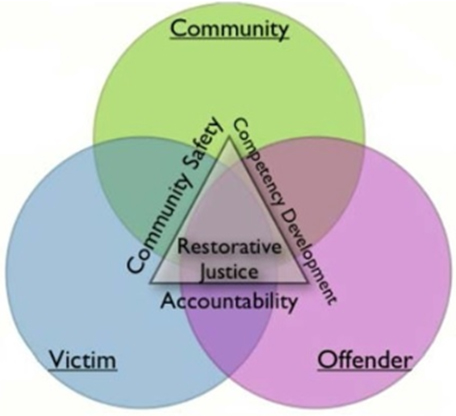
Properly administered, RJ processes produce individually tailored solutions involving interaction between offenders, victims and the community.
The word `community` I feel is important within the Nepali community. It will apply to other communities too.
Take an example of a Nepali elder having their jewellery stolen, which as many of you know has been a problem in some areas. RJ can include a member of the community too, say a community leader, who will be able to support the victim and explain the wider impact of their crime on the whole community.
RJ can take place at any stage of the criminal justice process including after conviction. It can also form an integral part of any sentencing, especially with youth offenders. Currently it is more common for the RJ process to be used before a case comes to court i.e. as part of a diversionary process, where the positive aspects are:
* An opportunity to provide reparation or compensation to any victim or relevant neighbourhood or community.
* Use of conditions to reflect and secure the interests of the victim and neighbourhood or community (for example by requiring the offender to stay away from a specific area.
* Use of restorative and reparative processes to have a positive impact on the community or individuals affected by the offending behaviour:
* Opportunities to provide reparative unpaid work that benefits the community:
* Use of a financial penalty condition to punish the offender and deter future offending.
Any police officer meeting with a victim of crime must be aware of RJ and discuss this with the victim to seek their views.
Once a criminal has been dealt with in the police station, then it is something that can be discussed with them too and the officer will then speak to the local RJ service in their area to commence the process.
There are various types of RJ processes in operation in the UK and in my next article, I will inform you about these.
Namaste.
PC 180 Mark Ranola.
Yateley Police Office.
101 (mark.ranola@hampshire.pnn.police.uk)