

This week I will write to let you know a bit more about Restorative Justice (RJ) because this is something that has more momentum and the use of it will only increase, because it is really is a way of helping victims to better understand the mind of the criminal, and to express to them the impact that the crime had on them.
The increased use of RJ will also allow the person who committed the crime understand that there are people whose lives are affected, rather than just think of them as an unknown person, so the victim becomes a real person to them. It also gives the criminal the opportunity to explain why they have committed the crime and perhaps their up-bringing, which victims don`t fully understand.
It is important to understand that the use of RJ does not replace the use of police cautions or court; it actually compliments the justice system, so someone found guilty of a crime is still dealt with in the usual way, but the RJ process can form part of a condition (something they have to do) of a caution or as part of their sentence at court.
Someone agreeing to become involved in RJ is likely to receive a reduced sentence because RJ is part of the rehabilitation process, so they would be less likely to re-offend if they take part.
It is something that both the person who commits the crime and the criminal need to agree to do. The types of RJ are below:
A Referral Order Panel meeting
Direct or indirect restorative justice processes
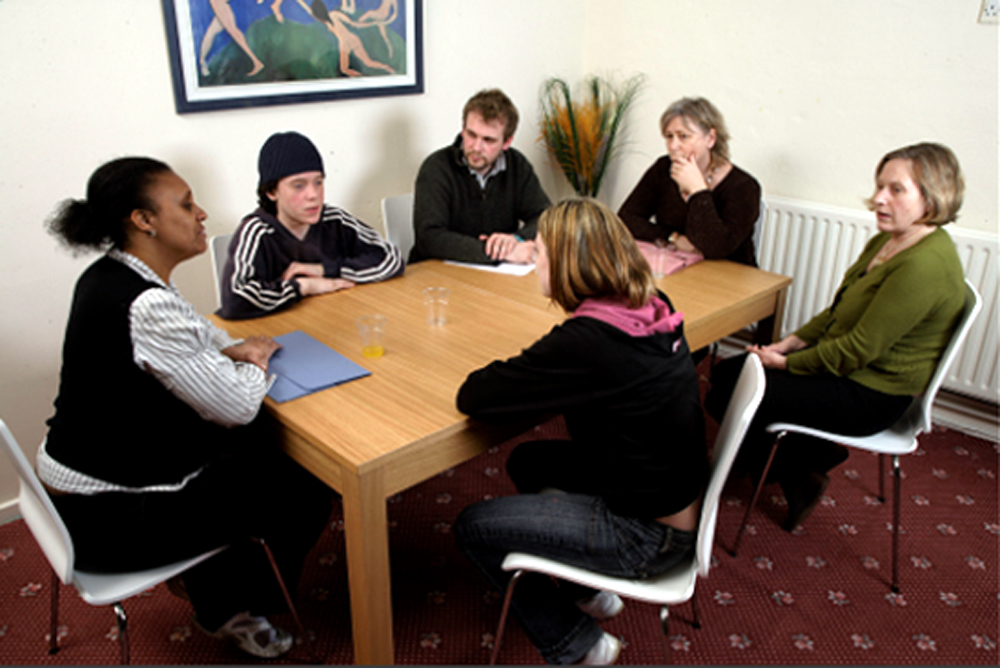
The victim and offender, guided by a facilitator, communicate with one another. Other people can also be involved in the process, such as supporters of the victims and perpetrator, and members of the wider community. This can take place through a direct face-to-face meeting, or, when several other people are involved, a conference; or indirectly with the facilitator acting as ‘go between’ in ‘shuttle mediation’. An agreement is usually reached to decide how best to repair the harm caused and a rehabilitative programme may be agreed.
Community conferencing
This is a large-scale conference particularly useful at resolving anti-social behaviour. These conferences can deal with large numbers of participants including local community members, several victims and perpetrators. In this approach the whole community can be the victim. This process is similar to community problem solving meetings. However, it is restorative if the process focuses on the harm caused and its resolution.
Referral order panels
Young people who receive a court Referral Order attend a panel meeting to discuss their offence and the factors that may have contributed to their offending behaviour. The panel is made up of Youth Offending Team staff and community volunteers. The victim, or their representative, may also attend so that their views may be put forward.
Mediation
Mediation is a process in which an impartial third party – the mediator – helps people in dispute work out an agreement. The people in dispute work out the agreement rather than the mediator, who runs the meeting with ground rules.
Lastly, may I wish the community a very happy and prosperous New Year of 2076.